Why Do You Think Art Is Important to People in North America
People are dying, disquisitional resource are stretched, the very essence of our freedom is shrinking – and all the same we are moved inward, to the vast inner infinite of our thoughts and imagination, a place nosotros have maybe neglected. Of all the necessities nosotros now feel so keenly aware of, the arts and their contribution to our wellbeing is evident and, in some ways, fundamental to coronavirus confinement for those of us locked in at abode. For some, there are more pressing needs. Only momentary joys, even in dire circumstances, ofttimes come through the arts and commonage expression.
As a lecturer in illustration, I am constantly encouraging students to observe an creative voice and identify, in this crowded world of images, some touchstones to develop their own aesthetic. Fine art critic and theorist John Berger identified, in the act of drawing, something that is inherently autobiographical – a continual process of refining vision which moves usa towards new understandings about ourselves and the world around the states.
In this time of crisis and isolation, the role of art becomes more central to our lives, whether we realise it or not. We can easily take for granted the yard buffet of media that is available to u.s. – and I can be guilty of a lack patience when students find it difficult discerning quality amid a sea of memes and amateur artistic indulgence which, to the unsuspecting, tin appear to be worthy. The lack of curation on the internet frustrates people like me who value culture and its contribution and equally, are chop-chop becoming grumpy old men and women.
Whether we like it or non our consumption habits – including media – form who nosotros are, our values, our inclinations. They are a patchwork of beliefs that are besides tested in these difficult times.
Art can set yous free
I was a loftier schoolhouse instructor in Sleepy Hollow, New York, 20 miles abroad from ground zero when the 9/11 attacks happened. It was a time like now that tested our collective ability to brand sense of a new normal and to mourn for the time earlier that would never come up back. A schism in the collective consciousness that anybody struggled to frame, even artists.
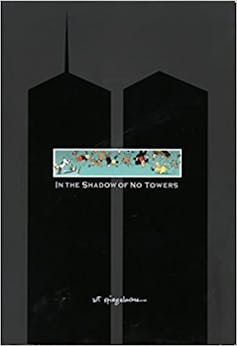
Art Speigelman'southward graphic novel In The Shadow of No Towers was less of a coherent narrative well-nigh 9/11 than an endeavor to reassemble his ain psyche through the comfort of his own creations and the medium of the comic itself.
People on social media are sharing favourite Netflix playlists, songs, videos and even artwork to achieve out beyond isolation and share what they dear. It is naive to recollect that such lists are mere coincidental swaps of entertainment enjoyed and recommended. They are an externalisation of the personality of the list maker: the romance enthusiast, the lover of comedies, the thrill seeker, the horror fan, and the aficionado of obscure documentaries.
Baca juga: Coronavirus: 5 musicals chosen by a musicologist to keep you lot going during lockdown
In this time of restriction, Boob tube, film, books and video games offer us a chance to be mobile. To move effectually freely in a fictional world in a way that is now incommunicable in reality. Fine art connects us to the strange, the exotic and the impossible – but in our current context, information technology also connects us to a world where anything is possible. A world out of our grasp for at present.
The world we wake upwards in is a counterfeit reality. Things look the aforementioned. Unlike those now familiar films, the descent of humanity is not apparent in the slow shuffle of moaning, burnished-eyed zombies. The threat we face feels like those clever horror movies like The Blair Witch Projection, Paranormal Activity and more recent films like The Tranquility Place where nosotros rarely encounter the source of horror. The current moment is best understood as a kind of low hum of anxiety, like the buzzing of a pylon in a field.
The world that was, the globe that is
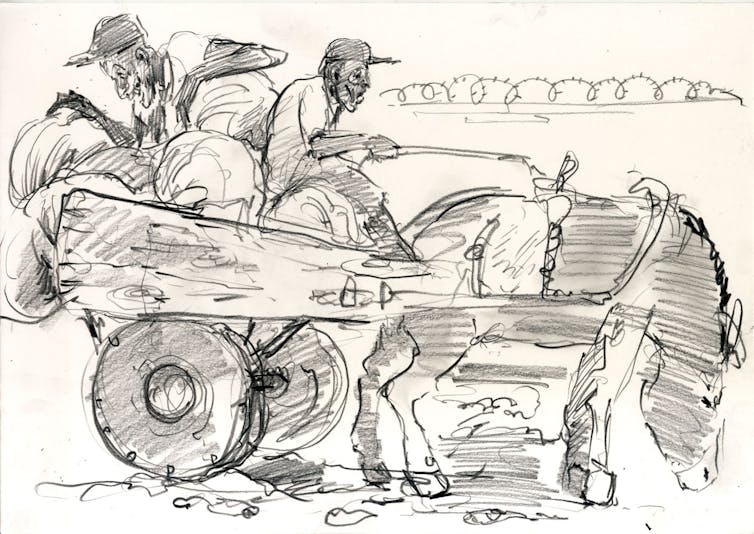
In my travels to Kenya in 2019 and more specifically Nairobi, I drew regularly. I was working on the Tupumue research project, measuring the lung capacity of 2,600 children aged between five and eighteen from ii areas in Nairobi: the informal settlement Mukuru and the adjacent flush area Buruburu.
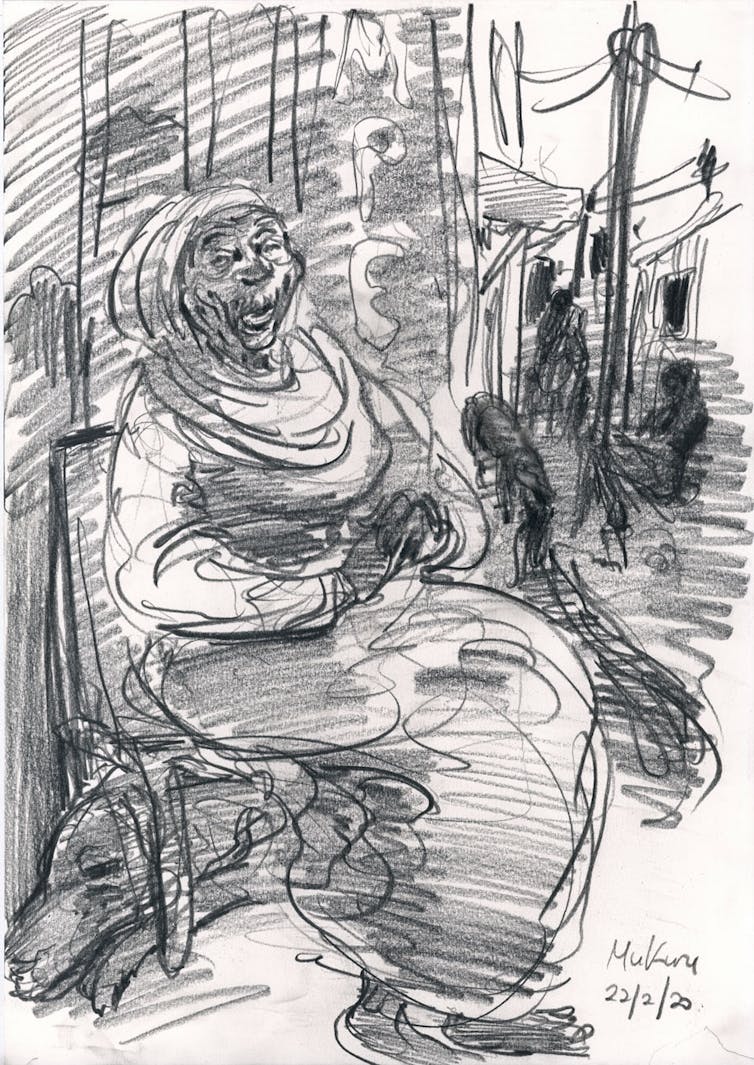
The research squad was collaborating with local artists, teachers and customs members to develop participatory creative methods to engage with the two communities in the report. The drawings capture my impressions of the vibrant streets of Nairobi and specifically of Mukuru, a large breezy settlement, is a visceral flood to the senses.
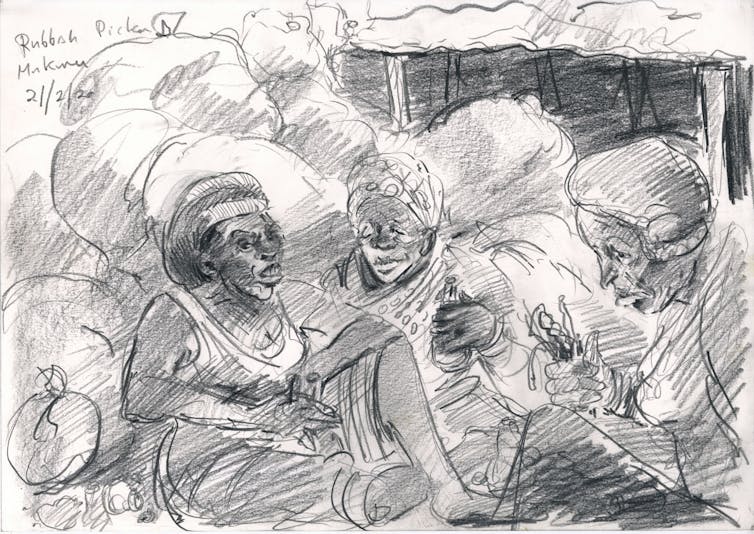
During an upshot in which we moved through Mukuru in procession, testing our creative methods for sensitisation which included puppetry, art making (including graffiti), song and trip the light fantastic, a colleague, surveying the crowds of children and people in the narrow, dusty roads, said: "I wouldn't desire to see what a virus would do to this population."
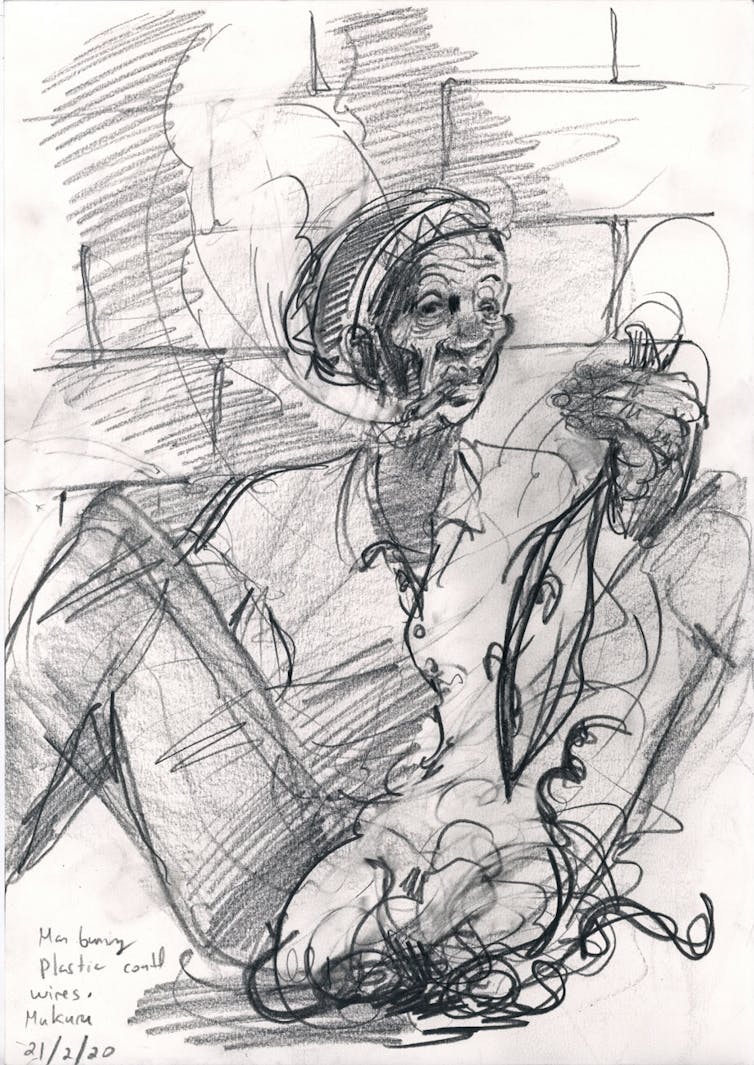
Nosotros are at present seeing this unfold and I worry for all of those people living in such close proximity. Self-isolation and the sharing of Netflix lists is an absurd luxury to the people here who live confined in pocket-sized, steel shacks. Life was difficult before COVID-nineteen. Later on, it could be unbearable.
A life in isolation is naught new, communities similar this have been isolated and invisible to the vast bulk of the globe for a long time. It is capitalism'due south dustbin. When capitalism coughs, these communities perish.
Baca juga: Why Africa's journalists aren't doing a good job on COVID-19
So what of the arts in isolation? It might be also early to write that book and paint that motion-picture show that captures the buzz of feet nosotros all feel. We probably demand more fourth dimension and artists need more sunrises and sunsets to rise and autumn on the full, nervous houses. They need more time to listen to the sounds of life interrupted and to mourn for the "world that was", watching information technology drift further into the shadows.
Source: https://theconversation.com/the-importance-of-art-in-the-time-of-coronavirus-135225
0 Response to "Why Do You Think Art Is Important to People in North America"
Post a Comment